Real Estate Depreciation and Taxes: What Every Landlord Needs to Know
If you own rental property and you’re not using depreciation to your advantage, you’re leaving money on the table — real money, every single year. Depreciation is one of the few tax benefits in the entire U.S. tax code that lets you deduct an expense you didn’t actually pay in cash that year. It’s not a loophole. It’s not aggressive. It’s built into the law because buildings wear out, and the IRS has always allowed owners to account for that.
But here’s the problem: most landlords either don’t understand depreciation well enough to use it properly, or they use it carelessly and get burned later. This article breaks down exactly how real estate depreciation works, how it interacts with your taxes, and where the real opportunities — and real risks — are.
What Depreciation Actually Is
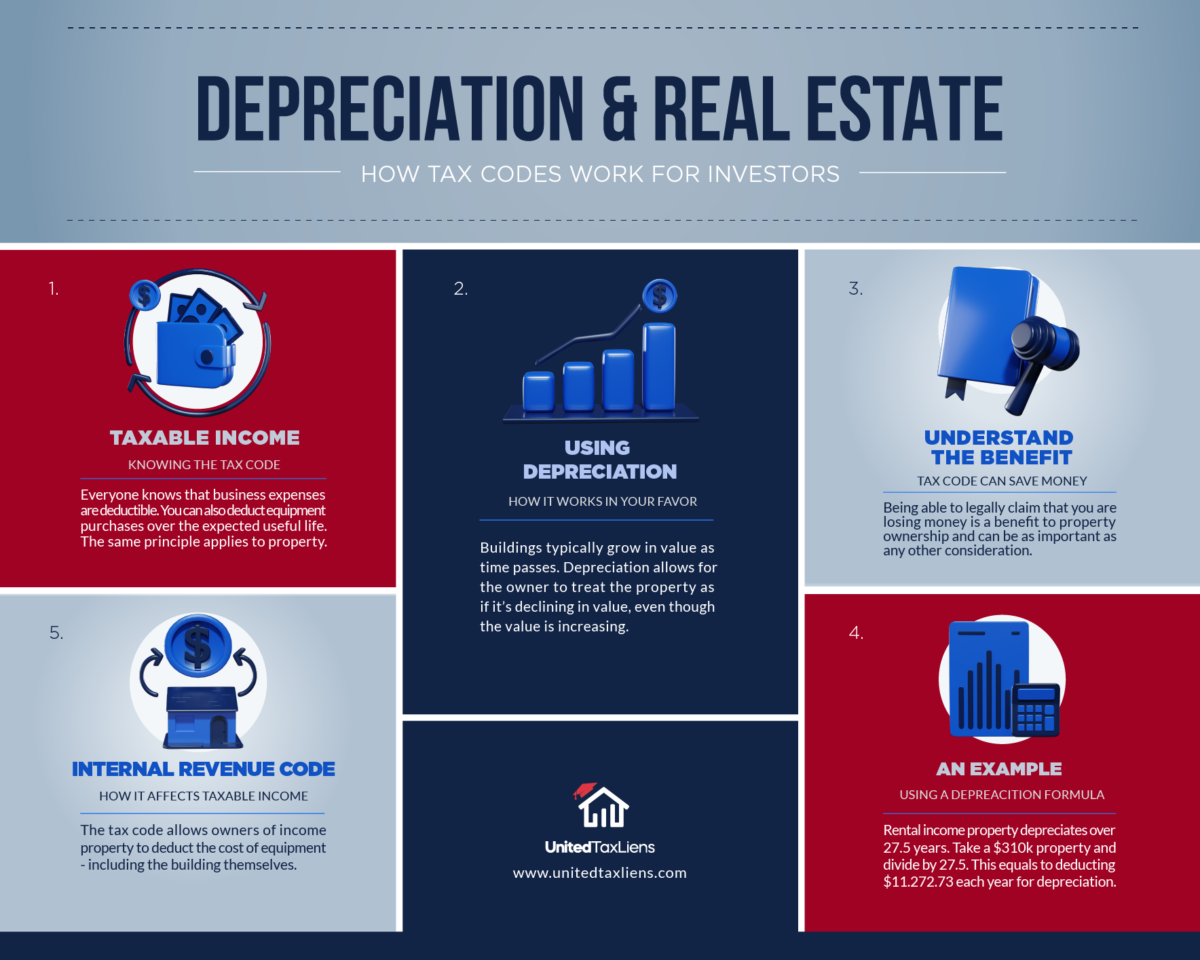
When you buy a rental property, the IRS doesn’t let you deduct the purchase price in the year you buy it. Instead, you spread that deduction out over the “useful life” of the building:
- Residential rental property: 27.5 years
- Commercial property: 39 years
Only the building counts — land is never depreciable, since land doesn’t wear out. If you buy a property for $500,000 and the land is valued at $100,000, you can only depreciate the remaining $400,000.
Using straight-line depreciation on a residential property, that $400,000 divided by 27.5 years gives you roughly $14,545 in depreciation deductions every year, whether or not the property actually lost any value. In many years, that deduction is larger than your actual cash flow from the property — which means depreciation can make a profitable rental show a loss on paper. That “paper loss” is where the real tax benefit lives.
Why Paper Losses Matter
Say your rental brings in $30,000 in rent and your actual cash expenses — mortgage interest, insurance, repairs, property management — total $25,000. You’ve got $5,000 in real cash flow. But once you subtract $14,545 in depreciation, your taxable income from that property drops to a loss of roughly $9,545.
You still pocketed the $5,000 in cash. You just don’t owe tax on it, and on top of that, you may have a loss you can use elsewhere. That’s the power of depreciation — it can shelter income you’ve actually collected.
The Catch: Passive Activity Loss Rules
This is where most landlords get tripped up. For the average taxpayer, rental real estate is classified as a passive activity. Passive losses can only offset passive income — they generally can’t be used to reduce your W-2 salary or active business income.
There’s a narrow exception: if your modified adjusted gross income is under $150,000 and you actively participate in managing the property, you can deduct up to $25,000 in rental losses against your ordinary income. That benefit phases out completely between $100,000 and $150,000 of income, so for many higher-earning landlords, it doesn’t apply at all.
If you’re stuck in the passive bucket with no passive income to offset, your losses don’t disappear — they carry forward indefinitely until you either generate passive income or sell the property. But “carry forward” isn’t the same as “usable now,” and that timing gap costs people real money.
The Real Estate Professional Status Escape Hatch
There’s one legitimate path around the passive loss trap: qualifying as a real estate professional under IRS rules. To qualify, you generally need to:
- Spend more than 750 hours per year in real property trades or businesses, and
- Spend more time on real estate activities than on any other work you do (meaning more than 50% of your total working hours).
If you qualify — and can document it, because the IRS scrutinizes this status heavily — your rental losses are no longer passive. They become fully deductible against your other income, including W-2 wages, business income, or investment income. For a landlord with a sizable portfolio and significant depreciation, this can mean converting hundreds of thousands of dollars in paper losses into an offset against ordinary income taxed at the highest marginal rates.
This status isn’t something you casually claim on a return. It requires a genuine time commitment and contemporaneous records — a log of hours, dates, and activities. The IRS has won plenty of court cases against taxpayers who claimed the status without proof. If you’re going to pursue it, track your time like your deduction depends on it, because it does.
Depreciation Recapture: The Bill Comes Due
Depreciation isn’t free money forever. When you sell a depreciated property, the IRS recaptures the depreciation you claimed and taxes it — currently at a maximum rate of 25% for real property, separate from your regular capital gains rate on the rest of the profit.
Here’s the math on why people get surprised: say you bought a building for $400,000 in depreciable basis, took $150,000 in depreciation over the years, and sold the property for a $300,000 gain. That $150,000 of the gain tied to depreciation gets recaptured at up to 25%, while the remaining gain is taxed at long-term capital gains rates. Landlords who never account for recapture in their exit planning often get blindsided by a tax bill much larger than they expected.
Cost Segregation: Accelerating the Benefit
Standard depreciation spreads deductions evenly over 27.5 or 39 years. A cost segregation study breaks a property down into its component parts — flooring, fixtures, parking lot, landscaping, certain electrical and mechanical systems — many of which qualify for much shorter depreciation periods (5, 7, or 15 years instead of 27.5 or 39).
This doesn’t create new deductions out of thin air; it accelerates deductions you were always entitled to, front-loading them into the early years of ownership. Combined with bonus depreciation rules (which have changed repeatedly in recent years and are worth checking current rates on before you rely on them), a cost segregation study can turn a five- or six-figure chunk of a purchase price into an immediate deduction rather than one spread across decades.
Cost segregation studies aren’t free — a professional study typically runs a few thousand dollars for a single property, more for larger or more complex assets — but for a landlord with a meaningful depreciable basis, the upfront cost is usually recovered many times over in accelerated tax savings.
1031 Exchanges: Deferring, Not Avoiding
Many landlords use a 1031 exchange to defer both the capital gains tax and the depreciation recapture when they sell, by rolling the proceeds into a new like-kind property. Done correctly, this can let you keep growing your portfolio without a tax event at every sale — but the rules on timing (45 days to identify a replacement property, 180 days to close) are strict and unforgiving. Miss a deadline, and the exchange fails entirely, triggering the full tax bill you were trying to defer.
The Bottom Line
Depreciation is one of the most powerful tools available to real estate investors, but it comes with strings attached: passive activity limitations, recapture on sale, and paperwork requirements that the IRS takes seriously. Landlords who understand how these pieces fit together — depreciation, passive loss rules, real estate professional status, cost segregation, and exchange strategy — can build a portfolio that generates real cash flow while legally minimizing the tax drag on that income.
Landlords who ignore these pieces tend to either underuse a benefit they’re entitled to, or get an unpleasant surprise at tax time when a property sells. Talk to a qualified CPA who specializes in real estate before you make major decisions here — the rules are precise, and small mistakes compound over the life of a property.
Mark Caldwell is a Midwest-based commercial real estate investor writing about practical, no-nonsense strategies for landlords and real estate investors.
Keep reading: 1031 Exchange Guide: How to Defer Capital Gains Taxes on Real Estate, NNN Lease Explained: What Regular Investors Need to Know, and What Is NOI in Real Estate? Net Operating Income Explained Simply.