The 50/30/20 Budget Rule: Does It Actually Work?
You’ve probably heard of the 50/30/20 rule. A senator wrote a book about it. Personal finance blogs repeat it constantly. It gets packaged as the simple, elegant answer to budgeting — the one rule you need to get your money right.
So does it actually work?
The honest answer: sometimes. For some people. Under certain conditions. And for a lot of middle-income Americans, it doesn’t fit their real lives at all — not because they’re doing something wrong, but because the rule itself has real limitations nobody talks about.
Let’s break it down plainly.
What Is the 50/30/20 Rule?
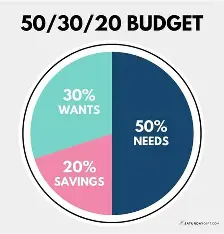
The 50/30/20 rule divides your after-tax income into three buckets:
- 50% goes to needs — rent or mortgage, utilities, groceries, insurance, minimum debt payments, transportation to work
- 30% goes to wants — dining out, entertainment, subscriptions, travel, hobbies
- 20% goes to savings and debt payoff — retirement contributions, emergency fund, extra debt payments
That’s it. Simple, clean, easy to remember. Senator Elizabeth Warren popularized it in her 2005 book All Your Worth, co-written with her daughter.
The appeal is obvious. Instead of tracking every dollar, you set three broad targets and go.
Where the 50/30/20 Rule Works Well
For someone earning $70,000–$100,000 a year in a mid-cost-of-living city — think Indianapolis, Columbus, Kansas City — the math can work. After federal and state taxes, you might clear $55,000–$75,000 annually. The 50/30/20 split lands you at:
- Needs: $27,500–$37,500/year (~$2,300–$3,100/month)
- Wants: $16,500–$22,500/year (~$1,375–$1,875/month)
- Savings/debt: $11,000–$15,000/year (~$917–$1,250/month)
In many Midwest and Southern cities, those numbers are workable. A modest apartment, a reliable used car, reasonable groceries — you can cover the essentials for $2,500–$3,000 a month and still have room left over.
It also works as a gut-check framework. Even if you don’t follow it precisely, it gives you a reference point. If you notice you’re spending 65% on needs, something’s off. If you’re saving 5%, you know you have room to grow. The three-category structure forces you to think about your money in a useful way.
Where It Breaks Down
Here’s where I’ll stop sugarcoating it.
Housing Costs Have Changed the Math
When this rule was written, housing costs looked very different. Today, in most major metro areas — Seattle, Denver, Miami, Los Angeles, New York, even mid-tier cities like Nashville or Austin — keeping housing under 30% of take-home pay is genuinely hard for anyone earning below $100,000.
If you earn $60,000 and take home $46,000, the 50% “needs” ceiling is $23,000 a year, or about $1,916 a month. In many cities, a one-bedroom apartment alone costs $1,800–$2,400. Before you pay for utilities, groceries, car insurance, or health insurance, you’re already at or over your “needs” budget.
This isn’t a budgeting failure. It’s a math problem. The 50/30/20 rule was designed for a housing market that no longer exists in many parts of the country.
It’s Generous with “Wants” and Stingy on Reality
Thirty percent for wants sounds reasonable until you realize how many things get classified there. A gym membership. A streaming service. That birthday dinner for your friend. The occasional new pair of work shoes. One weekend trip a year.
Wants can add up fast — and 30% of take-home pay at $60,000 is $13,800 a year, or $1,150 a month. That sounds like a lot until housing has already eaten most of your budget and you’re watching every discretionary dollar.
Meanwhile, 20% for savings and debt is the right instinct, but for someone carrying significant student loans or credit card debt, 20% may not be aggressive enough to actually make progress.
It Doesn’t Account for Income Level
The 50/30/20 rule works better as income rises. That’s because certain fixed costs — insurance, a basic car, utilities — don’t scale with income. At $120,000 take-home, a 50% needs budget is $60,000. You have a lot of room. At $40,000 take-home, a 50% needs budget is $20,000. In most American cities, that’s not enough to cover the basics.
The rule was genuinely designed for middle-class earners, not for people just starting out, not for people in high-cost cities, and not for people with significant debt loads.
What to Do Instead (Or Alongside)
None of this means you should throw the framework out. It means you should use it with your eyes open.
Adjust the Percentages to Your Actual Life
If you’re in a high cost-of-living area and housing legitimately takes 35% of your take-home, adjust. Maybe your split is 55/20/25. Maybe it’s 60/15/25. The percentages are a guideline, not a law. What matters is that you’re intentionally allocating toward savings and not just spending whatever’s left.
The core insight — make savings automatic and non-negotiable — is worth keeping even when the specific numbers don’t fit.
Track Actual Spending for 30 Days First
Before you try to follow any rule, spend one month just tracking what you actually spend. No changes, no guilt, just data. Most people are genuinely surprised. They find they’re spending more on food than they thought, less on entertainment, or that “miscellaneous” has become a significant category.
You can’t budget effectively against a framework until you know your real baseline.
Prioritize the 20% First
Here’s the biggest practical change you can make to how this rule is typically taught: save and pay extra debt first, not last.
Most people treat savings as what’s left after spending. That’s backwards. If you make saving automatic — directly from your paycheck into a 401(k) or separate savings account — you never see the money, so you never spend it. The 50% and 30% categories then fill in around what remains.
This is how people actually build wealth. Not by restraining discretionary spending at the margins, but by making savings automatic and non-negotiable from day one.
Use the Framework to Diagnose, Not Prescribe
The 50/30/20 rule is most useful as a diagnostic tool. Run your actual spending through it quarterly. If your “needs” percentage is ballooning, that’s a signal — maybe housing is too expensive for your income, maybe a debt payment has gotten out of hand, maybe a recurring “need” isn’t actually one.
Used this way, it’s genuinely helpful. Used as a rigid formula, it’s frustrating and often not achievable.
A Quick Reality Check: Running the Numbers
Here’s how the rule plays out at three different income levels, using approximate take-home after federal and state taxes for a single filer:
| Gross Income | Est. Take-Home | 50% Needs | 30% Wants | 20% Savings |
|---|---|---|---|---|
| $45,000 | ~$36,000 | $1,500/mo | $900/mo | $600/mo |
| $75,000 | ~$57,000 | $2,375/mo | $1,425/mo | $950/mo |
| $110,000 | ~$80,000 | $3,333/mo | $2,000/mo | $1,333/mo |
At $45,000, keeping needs to $1,500/month is difficult in most American cities once you include rent, transportation, insurance, and groceries. At $75,000 it’s more achievable. At $110,000 it’s quite workable.
This is why the rule gets a better reception from higher earners and frustrates people earlier in their careers or living in expensive metros.
The Bottom Line
The 50/30/20 rule is a decent starting framework, not a finished answer. It gives you three categories that matter, encourages you to actually save, and forces you to think about your spending in terms of priorities. Those are real virtues.
But it was designed around a housing market and cost structure that has shifted dramatically in 20 years. It doesn’t scale well to lower incomes. And it’s too forgiving on the wants side for anyone carrying high-interest debt.
Use it as a benchmark. Adjust the percentages to match your actual situation. Automate the savings piece first. And stop beating yourself up if your numbers don’t hit 50/30/20 exactly — the goal is progress, not perfection.
If you’re spending less than you earn, saving consistently, and making progress on debt, you’re doing it right. That’s the whole game, regardless of what the percentages say.
Mark Caldwell is a Midwest-based commercial real estate investor and the founder of PlainMoneyAdvice.com. His writing focuses on practical personal finance for everyday Americans — without the jargon, the hype, or the affiliate-link agenda.
Keep reading: Emergency Fund: How Much Do You Actually Need?, Net Worth Calculator: How to Track What You Actually Own, and How to Pay Off Debt Faster: The Avalanche vs. Snowball Method Explained.